By Raghavendra Prasad Meeniga | Vice President of Technology
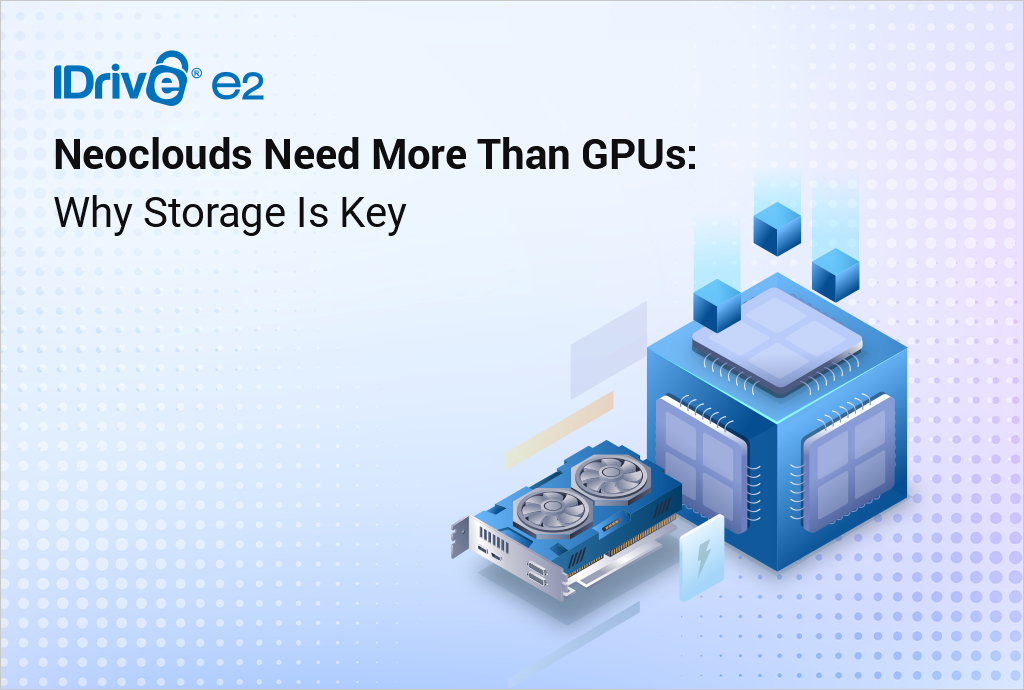
Neoclouds are reshaping AI infrastructure with high-performance GPU platforms built for training, inference, and other compute-intensive workloads. As these platforms scale and customers move more AI workloads into production, storage becomes an increasingly important part of the infrastructure.
Training datasets need to be stored. Model checkpoints need to be retained. Model weights need to be available for inference. Generated images, video, logs, and application data continue to grow long after a GPU job is finished.
For neoclouds, that means storage can no longer be treated as an afterthought. It needs to be part of the platform strategy.
Storage Can Slow You Down
High-performance storage close to GPUs is important for active AI workloads.
But not every dataset needs to stay on expensive NVMe or high-performance file storage all the time.
A training dataset may be heavily used today and then sit untouched for weeks. Checkpoints may need to be retained for months. Model artifacts and generated data may remain long after the compute job ends.
This is where S3-compatible object storage fits naturally.
Keep the hottest data on high-performance storage when the GPUs need it. Keep the much larger pool of persistent data on scalable object storage.
The challenge comes when compute and storage live in completely different clouds.
Large datasets, checkpoints, and model artifacts have to move between providers, adding egress costs, API charges, and more infrastructure for customers to manage.
For data-intensive AI workloads, that friction can add up quickly.
Don’t Build Everything Yourself
A neocloud can build its own object storage platform.
Open-source platforms such as Ceph make that look attractive, especially at the beginning.
But there is a big difference between deploying a storage cluster and operating one reliably at scale.
As capacity grows, teams have to deal with hardware failures, rebalancing, networking, performance tuning, upgrades, monitoring, capacity planning, and data durability.
What starts as an infrastructure project can quickly become a permanent storage engineering responsibility.
And for most neoclouds, storage is not where they want to differentiate.
The real focus is GPU utilization, cluster scheduling, networking, Kubernetes, inference, bare-metal provisioning, and developer experience.
Your engineers should be improving the AI platform, not troubleshooting storage clusters.
This is also why AI infrastructure is becoming more composable. Neoclouds can focus on the compute and AI services that differentiate their platforms while relying on specialized providers for other infrastructure layers such as object storage.
Offer Storage With Your Compute
If customers run GPUs with you but keep all their data somewhere else, the experience stays fragmented.
Compute is with one provider.
Storage is with another.
Customers have to move datasets between the two and manage separate accounts, credentials, billing, and potentially unpredictable data-transfer costs.
Offering object storage alongside GPU compute makes the platform much simpler.
Customers can upload a dataset once, train against it, retain checkpoints, run future jobs, and store generated data through the same provider.
For the neocloud, storage also becomes another service it can offer to the same customer.
GPU workloads may run for hours or days. The data around those workloads can remain for months or years.
That makes storage not just part of the infrastructure, but also a recurring revenue opportunity.
How IDrive® e2 Helps Neoclouds Move Faster
IDrive e2 gives neocloud providers a way to add S3-compatible object storage without building and operating another storage platform from scratch.
Depending on the environment, storage can be offered under the neocloud’s own brand or deployed directly inside the same data center as its GPU infrastructure.
Add Storage Under Your Own Brand
- IDrive e2 reseller APIs allow neocloud providers to integrate S3-compatible object storage directly into their existing cloud platform.
- Customer onboarding, provisioning, user management, storage operations, usage reporting, and billing can all be automated through APIs.
- Custom domains and white-label options keep the storage experience under the neocloud’s own brand.
- Instead of sending customers to another cloud storage provider, storage becomes another service inside the neocloud platform.
- The neocloud controls the customer relationship, pricing, and margins.
- IDrive e2 manages the storage infrastructure behind it.
Keep Storage Close to the GPUs
- For larger AI environments, IDrive e2 can deploy dedicated S3-compatible object storage directly inside the neocloud’s data center.
- The neocloud provides rack space, power, and network connectivity.
- IDrive e2 provides the hardware and manages the storage platform, including installation, monitoring, and maintenance.
- This keeps large datasets close to the GPU infrastructure and avoids moving data back and forth between geographically separate clouds.
- It also gives the neocloud a dedicated object storage layer without having to build and maintain a separate storage operations team.
- As AI environments grow into petabytes, keeping storage close to compute becomes increasingly important.
Keep Storage Costs Predictable
- AI workloads can move and access enormous amounts of data.
- Traditional cloud storage pricing can become difficult to predict when storage costs are combined with API requests and data-transfer charges.
- IDrive e2 keeps the model simpler, with free ingress, no API or deletion fees, and free egress up to three times the active storage volume.
- For neocloud providers building storage into their own services, predictable storage economics also make it easier to create straightforward pricing for customers.
Start with a POC
Every neocloud environment is different.
Different GPUs. Different networks. Different workloads. Different data patterns.
Storage performance is difficult to judge from a specification sheet alone.
For qualifying deployments, IDrive e2 can fund and deploy the initial proof of concept directly inside the neocloud’s data center.
The provider supplies rack space, power, and network connectivity. IDrive e2 supplies and manages the storage infrastructure.
Then test it in the real environment.
Move real datasets.
Connect it to the actual GPU network.
Run real workloads.
Measure throughput and latency.
See how the architecture performs before making a large infrastructure commitment.
If it works, there is already a practical path to scale.
Let IDrive® e2 Handle the Storage
Neoclouds are succeeding because they specialize.
They are building better GPU infrastructure and AI platforms instead of trying to recreate every service offered by a hyperscaler.
Storage can follow the same model.
Neoclouds need storage, but they do not necessarily need to build another storage company inside their company.
IDrive e2 can provide the S3-compatible storage layer through the cloud, under the neocloud’s own brand, or directly inside the same data center as its GPU infrastructure.
Keep building the GPU platform. Let IDrive® e2 handle the storage behind it.
Building or Expanding a Neocloud?
Talk to the IDrive e2 team about white-label S3 storage, dedicated storage infrastructure, or an IDrive-funded proof of concept inside your data center.
Talk to the IDrive e2 Team