How a structural “Verification-Cost Floor” in the vacuum lattice solves the dark matter anomaly.
By Raghu Kulkarni | SSMTheory Group, IDrive Inc.
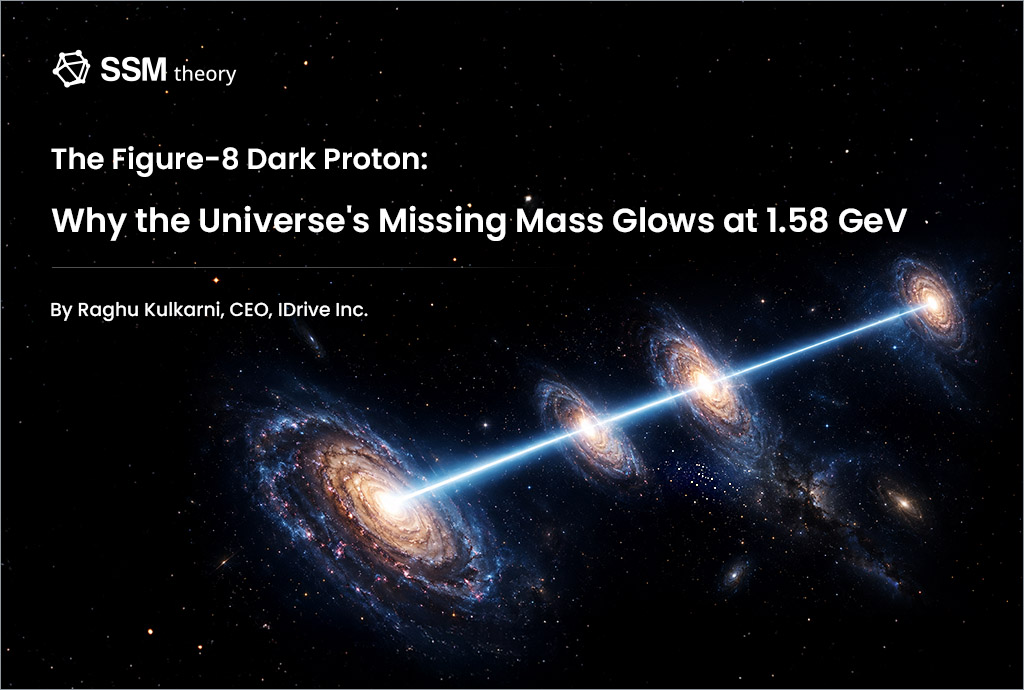
For decades, physicists have been hunting for the “smoking gun” of dark matter: a sharp, distinct gamma-ray line in deep space. When dark matter particles collide and annihilate, they should theoretically produce a flash of light at a very specific energy level. Recently, the astronomical community got exactly that. Analyzing Fermi-LAT data, Kang et al. (2026) detected a highly significant gamma-ray line at exactly 1.58 GeV radiating from three active galactic nuclei.
But interpreting this signal requires a theoretical framework. In modern physics, theorists often resort to adding “free parameters”—invisible knobs they can twist in their equations until the math magically fits the telescope data. At the IDrive SSMTheory Group, we don’t use free parameters. We model the physical vacuum as a rigid Face-Centered Cubic (FCC) lattice, where particle masses are dictated purely by structural geometry.
The SSM Prediction vs. The Telescope
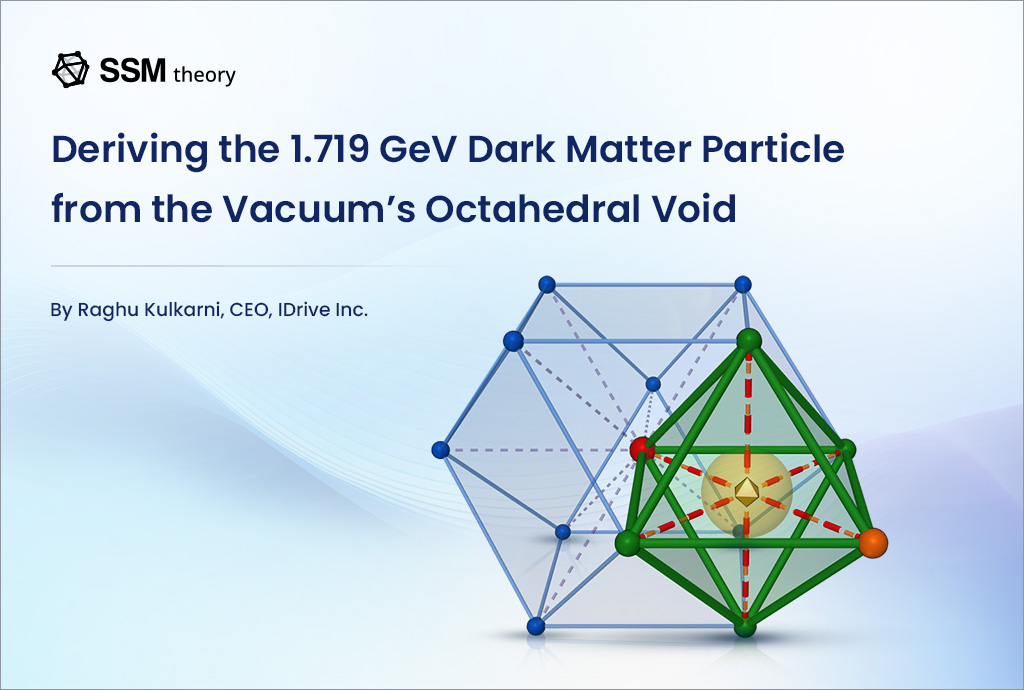
In our Selection-Stitch Model (SSM), dark matter isn’t a ghostly fluid; it is a specific structural defect (a “K=6” trapped node) inside the vacuum lattice. Based entirely on the combinatorial counting of these lattice bonds, we previously derived the mass of this primary dark matter defect to be exactly 1.7195 GeV.
Under standard particle physics assumptions, if two particles annihilate directly into two photons, the resulting flash of light must exactly match their rest mass. So, if the SSM predicts dark matter is 1.7195 GeV, standard physics dictates it should produce a 1.7195 GeV photon. When Kang et al. found a 1.58 GeV line instead, it looked like a glaring mismatch. Was our 1.7195 GeV derivation wrong?
The Breakthrough: The Dark Proton Recoil
Not at all. The standard assumption—that the particles vanish completely into photons—is physically impossible in our framework. In our latest paper, we prove the existence of a Verification-Cost Floor (VCF)—a physical limit enforced by the immense “metric wall” of the surrounding vacuum lattice. The lattice mathematically refuses to let the particle’s structural base dissolve completely.
Instead of vanishing into thin air, the collision leaves behind a heavy, sterile piece of shrapnel: a “figure-8 dark proton.
This residual particle (a K=4 defect trapped in an octahedral void) is electromagnetically neutral, color-singlet, and self-conjugate. It is an utterly invisible, stable ghost particle. But importantly, it has mass. By un-gauging the standard visible proton’s structural count, we derive the dark proton’s mass to be exactly 0.9567 GeV.
Billiard Ball Physics
This is where the model’s internal consistency shines. When the two primary dark matter particles (1.7195 GeV each) annihilate, they kick out this heavy, invisible dark proton. Because the universe strictly enforces the conservation of energy and momentum, we can calculate the exact energy of the single photon emitted alongside it.
When you run the two-body kinematic equations, the heavy recoil of the 0.9567 GeV dark proton drains a massive chunk of energy away from the flash of light. The photon is dynamically down-shifted from 1.719 GeV to exactly 1.586 GeV.
Boom. The pure lattice math matches the telescope data. Without tweaking a single free parameter, the 1.7195 GeV primary particle perfectly produces a photon line within 0.17σ of the Kang et al. observation.
The Earthly Connection
This framework doesn’t just solve mysteries in deep space; it explains the frustration of physicists right here on Earth. For years, massive underground direct-detection experiments (like CRESST-III) have been searching for dark matter by waiting for it to bump into standard atoms. Every time they lower their detection threshold to probe the sub-1.7 GeV mass range, they hit a sudden wall of unexplained “low-energy excess” anomalies.
Our model explains exactly why. The primary dark matter particle sits right at the 1.719 GeV boundary. Meanwhile, the universe is slowly filling up with a cold, collisionless gas of 0.9567 GeV dark protons that are structurally immune to standard terrestrial detectors.
Don’t Take Our Word For It. Run the Math.
Theoretical physics should be transparent and reproducible. We have bundled the combinatorial counting, the two-body kinematic chain, and the energy-budget conservation into an open-source Python script. We invite the physics community to run the code and verify the 1.586 GeV derivation themselves.
Read the technical papers here:
“Deriving the Dark Matter Annihilation Channel from Metric-Wall Confinement” (DOI: 10.5281/zenodo.20372215)
“Dark matter as a trapped K=6 remnant in the octahedral voids” (DOI: 10.5281/zenodo.20047901)
Access the computational verification script and all SSMTheory Group research at
idrive.com/ssmtheory