
By Raghu Kulkarni, CEO, IDrive Inc.
Interactive 3D Visualization: The Octahedral Void and Dark Matter Geometry
For decades, the search for dark matter has followed a familiar playbook: invent a new hypothetical particle, add a handful of adjustable free parameters, tune them until they match cosmological observations, and hope a detector eventually finds something.
But what if dark matter isn’t a new exotic particle at all? What if it is a strictly required, geometric consequence of the vacuum itself?
In the Selection-Stitch Model (SSM), we treat the physical vacuum not as an empty void, but as a Face-Centered Cubic (FCC) crystallization of spacetime. In our previous papers, we demonstrated that baryonic matter (like the proton) is simply a structural defect—a K = 4 remnant—trapped inside the tetrahedral interstitial voids of this FCC lattice.
But anyone familiar with basic crystallography knows that the FCC lattice contains exactly two types of interstitial voids. If normal matter is trapped in the tetrahedral voids, what is sitting in the other one?
Following rigorous theoretical stress-testing of our earlier dark matter candidates, we have published a revised manuscript: “Dark Matter as a Trapped K = 6 Remnant in the Octahe-dral Voids of the FCC Vacuum Lattice.” This updated paper abandons forcing cosmological thermodynamic ratios and instead focuses purely on the immutable topology of the vacuum’s second void.
The Octahedral Defect: A K = 6 Vacuum Knot
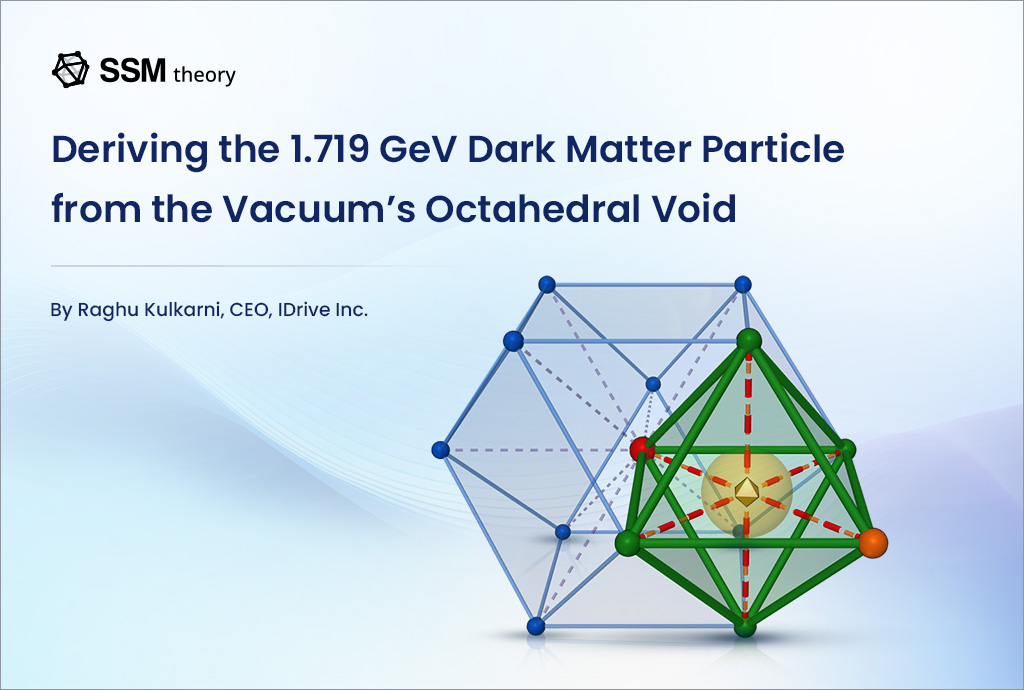
The second void in the FCC unit cell is the octahedral void, bounded by 6 lattice vertices. If a defect is trapped here during the vacuum’s crystallization, it forms a K = 6 structural knot.
Because the trapped node bonds to its six bounding vertices, its internal bonding graph forms a complete tripartite graph known as K2,2,2. We did not invent this shape; it is an immutable crystallographic fact of the FCC lattice.
When we analyze the topology of this K2,2,2 defect, an incredible picture emerges. Without tuning a single parameter, the rigid geometry of this structure produces exactly the four qualitative properties required of cold dark matter:
- It is Electromagnetically Neutral (Dark): The defect’s bounding regular octa-hedron has 8 triangular faces, but exactly zero square faces. In the SSM framework, square faces carry the bipartite oscillation modes required to couple to photons. No square faces means no first-order electromagnetic coupling. It is completely dark.
- It is Colorless: Standard baryonic defects derive their 3-color SU (3) strong force charge from the 3 skew-edge pairs of their tetrahedral bounding box. The K = 6 octahedral defect possesses exactly 30 skew-edge pairs. Because 30 does not neatly factor into a three-color representation, the defect cannot participate in standard QCD interactions.
- It is its Own Antiparticle (Majorana-type): The regular octahedron has perfect spatial inversion symmetry—it is its own mirror image. Therefore, the defect has no distinct “anti-particle” orientation, meaning no matter/antimatter asymmetry is required to explain its cosmological abundance.
- It Forms Collisionless Halos: Because it cannot emit photons, it cannot shed kinetic energy through radiative cooling. Without a cooling channel, it cannot collapse into dense stars or planets. It is condemned to remain a diffuse, collisionless halo—exactly matching the observed phenomenology of dark matter in almost-dark galaxies.
The Mass Prediction: 1.719 GeV
The SSM framework doesn’t just predict the qualitative behavior of particles; it calculates their exact masses by counting the fault-tolerant verification overhead of their topological structures.
For the proton, our established structural counting gave a cost of 1836.
When we apply the exact same mathematical expansion (the Principle of Inclusion-Exclusion) natively to the K2,2,2 bonding graph of the octahedral defect, the series rigidly terminates at the third order (because an octahedron’s 6 vertices physically forbid any 4-matching).
The calculation yields an exact structural verification cost of 3364.
Comparing this topological weight directly to the proton, we get a rigid, forward mass prediction for dark matter:
(3364/1836) × 0.938 GeV = 1.719 GeV.
This is a forward prediction derived from pure combinatorics. No cosmological abundance ratios were consumed to produce this number.
The Observational Anchor
Does a 1.719 GeV dark matter particle exist in the real universe?
A recent 2026 Fermi-LAT analysis by Kang et al. reported the discovery of a universal gamma-ray line at approximately 1.55 GeV originating from three active galactic nuclei (AGN).
While a naive look suggests our 1.719 GeV prediction is roughly 11% too high, we have to look at where the signal is coming from. AGN host supermassive black holes surrounded by dense dark matter spikes. When dark matter annihilates deep in this gravitational well, the emitted photons must climb out, experiencing gravitational redshift.
A 1.719 GeV rest-frame photon emitted at a radius of roughly 5 Schwarzschild radii will naturally redshift down to exactly ∼ 1.55 GeV by the time it reaches our telescopes.
The End of Parameter Fitting
The dark matter problem has persisted because we have treated it as a missing piece we are allowed to invent. The SSM framework shows us that we don’t need to invent anything. If normal matter is simply the topological knots occupying the FCC vacuum’s tetrahedral voids, then dark matter is simply the companion knots occupying the octahedral voids.
Its darkness, its inability to form stars, and its exact 1.719 GeV mass are not features we programmed into a model. They are the immutable laws of geometry, hiding in plain sight.
Read the full revised manuscript here: https://doi.org/10.5281/zenodo.20047901
Explore all SSMTheory framework papers:https://www.idrive.com/ssmtheory-physics/ |
https://www.idrive.com/ssmtheory-quantum/.