
By Raghu Kulkarni | SSMTheory Group, IDrive Inc.
As quantum processors scale from hundreds to thousands of qubits, hardware engineers are
slamming into a physical brick wall: The Wiring Problem. To build a fault-tolerant quantum computer, qubits need to be wired together to check each other for errors. Currently, the industry is caught in a frustrating compromise between two extremes:
- Surface Codes: Hardware engineers love these because they require strict K=4 planar connectivity. Each qubit only wires to its four immediate neighbors, like a flat checkerboard. The problem? If a qubit on the left side of the chip needs to perform a logical gate with a qubit on the right side, it can’t. Surface codes lack native “cross-block” communication.
- qLDPC / Bivariate Bicycle Codes: Theorists love these because they allow completely different blocks of qubits to talk to each other, saving a massive amount of overhead. The problem? They require K=6 connectivity and messy “long-range” wires that jump over one another, introducing severe crosstalk and manufacturing nightmares
At the IDrive SSMTheory Group, we asked a simple question: Can we get the cross-block
communication of a qLDPC code using the easy-to-build, K=4 wiring of a surface code?
In our latest paper, “Three Sheets on One Chip,” we prove that the answer is yes. The secret lies in
the geometry of the Face-Centered Cubic (FCC) lattice.
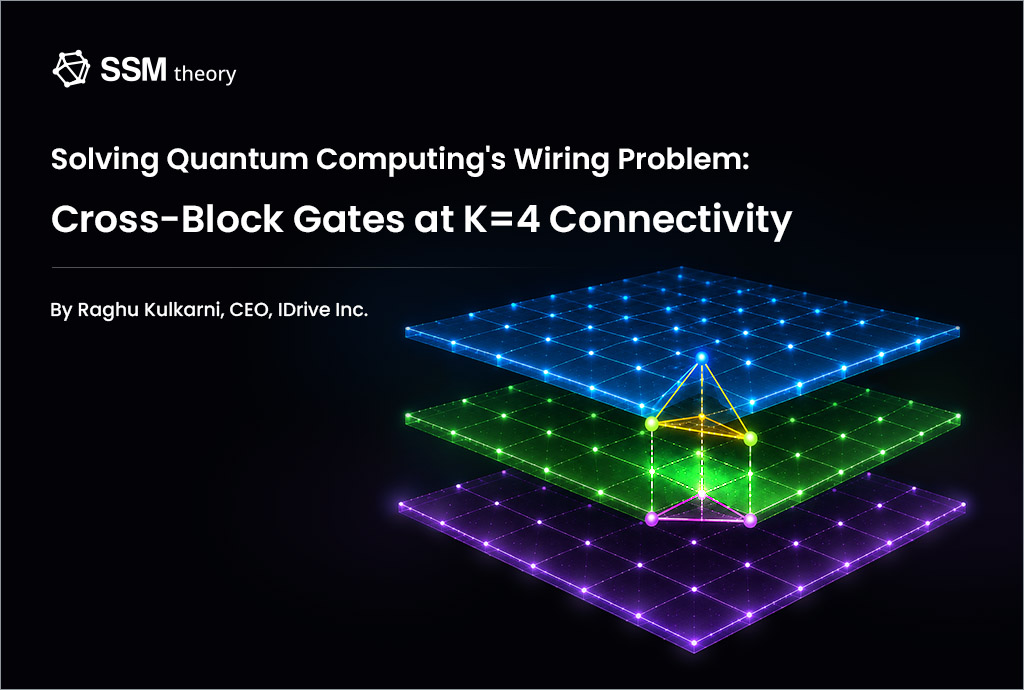
The Triad Decomposition: Three Sheets in One Space
Instead of trying to force long-range wires onto a 2D checkerboard, we started with a 3D structure: the Face-Centered Cubic (FCC) lattice—the same geometry nature uses to pack oranges in a grocery store.
Through a mathematical process called the Triad Decomposition, we discovered that the 3D FCC
lattice can be perfectly sliced into three independent, orthogonal 2D sheets. If you isolate just one of these sheets, it behaves exactly like a standard, highly efficient quantum surface code. It has perfect K=4 connectivity and local weight-4 stabilizers.
But we didn’t just isolate one sheet. We packed all three sheets back together into the same physical volume. This allows us to encode three times as many logical qubits in the same space, but more importantly, it unlocks a hidden hardware feature.
The Breakthrough: Cross-Sheet Triangle Surgery
If you pack three independent 2D sheets into the same 3D space, their edges are going to cross. In the FCC lattice, the exact points where these three sheets intersect form tiny geometric triangles.
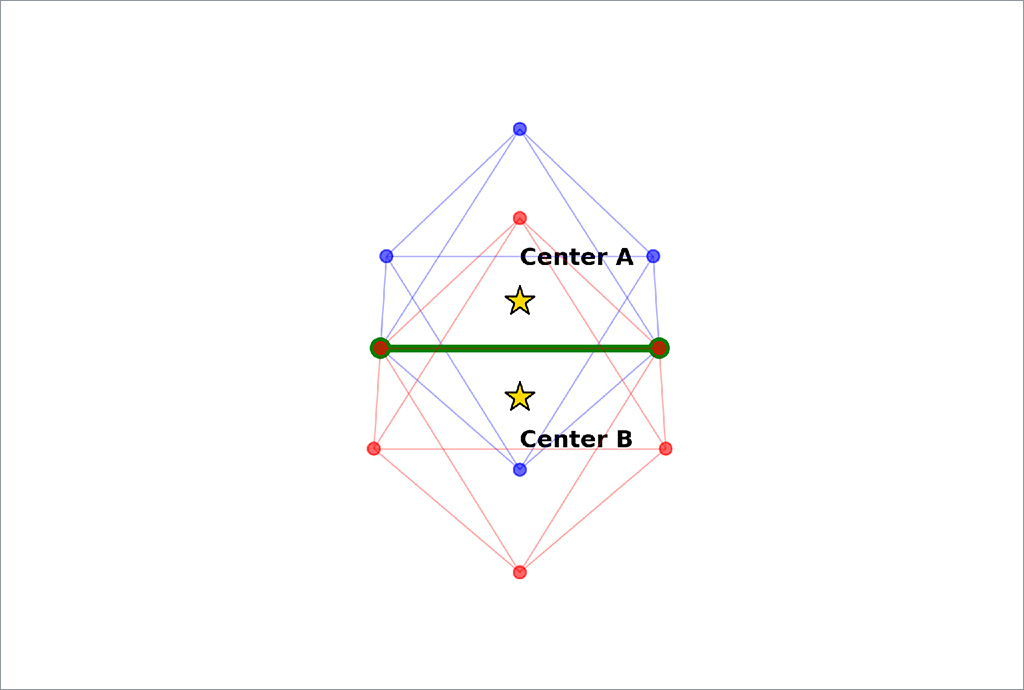
Figure 1: Every FCC triangle has exactly one edge in each triad sheet. A single weight-3 Pauli measurement on a triangle simultaneously couples data qubits across all three sheets.
We realized that these triangles are not just a geometric curiosity—they are native, built-in hardware couplers. Normally, if you want a qubit on “Sheet A” to talk to a qubit on “Sheet B,” you have to build a permanent, noisy, long-range wire between them. In our architecture, you don’t have to build a permanent wire at all. Instead, we use a protocol called Lattice Surgery.
By performing a simple, localized measurement on the FCC triangle where the sheets cross, we create a temporary bridge. For a brief microsecond, Sheet A and Sheet B are entangled. They perform a joint logical gate, exchange their information, and then the bridge disappears.
We achieve complex, cross-block logical gates without ever breaking the golden rule of hardware
manufacturing: every physical qubit still only connects to 4 neighbors.
The Hardware Blueprint: 3D Stacking
How do you actually build this without creating a giant, monolithic 3D nightmare? You build it using technology that semiconductor foundries already master.
Because the architecture naturally separates into 2D planar layers, it is perfectly suited for a three-layer stacked architecture. Using modern flip-chip bonding or multi-layer silicon interposers, hardware manufacturers can print three separate 2D chips (each with easy K=4 wiring) and stack them on top of one another. The “triangles” simply become the vertical vias connecting the layers.
You get the density and cross-block communication of a 3D code, with the low-noise, easy-to-manufacture wiring of a 2D surface code.
The Results
We simulated this architecture under circuit-level depolarizing noise using standard Minimum Weight Perfect Matching (MWPM) decoders. The results confirm its fault tolerance:
- Static Memory Threshold: ~0.63%
- Triangle Surgery Threshold: ~0.5%
Both of these thresholds sit comfortably above the operating error rates of current, state-of-the-art quantum processors.
At IDrive, we are committed to pushing the boundaries of what is physically and computationally
possible. IDrive Inc. has filed comprehensive provisional patents covering this triangle-
mediated cross-block architecture (Patent Pending), and we are excited to share the rigorous
mathematical blueprint with the quantum community.
Read the full technical paper here:
“Three Sheets on One Chip: Cross-Block Gates for K=4 Quantum Error Correction” (DOI: 10.5281/zenodo.19412464)
Access the computational verification suite, open-source repositories, and all SSMTheory Group research at:
https://www.idrive.com/ssmtheory-physics/ |
https://www.idrive.com/ssmtheory-quantum/.