For over a century, physics has been anchored by Einstein’s famous equation, E = mc2, which proved that mass and energy are two sides of the same coin. But as we dive deeper into quantum mechanics, a third fundamental pillar is emerging: Information.
At IDrive, we spend our days obsessing over data integrity, error-correction algorithms, and decentralized storage architectures. But what if the universe itself operates on these exact same principles? What if the fabric of spacetime isn’t an empty void, but a massive, fault-tolerant quantum hard drive?
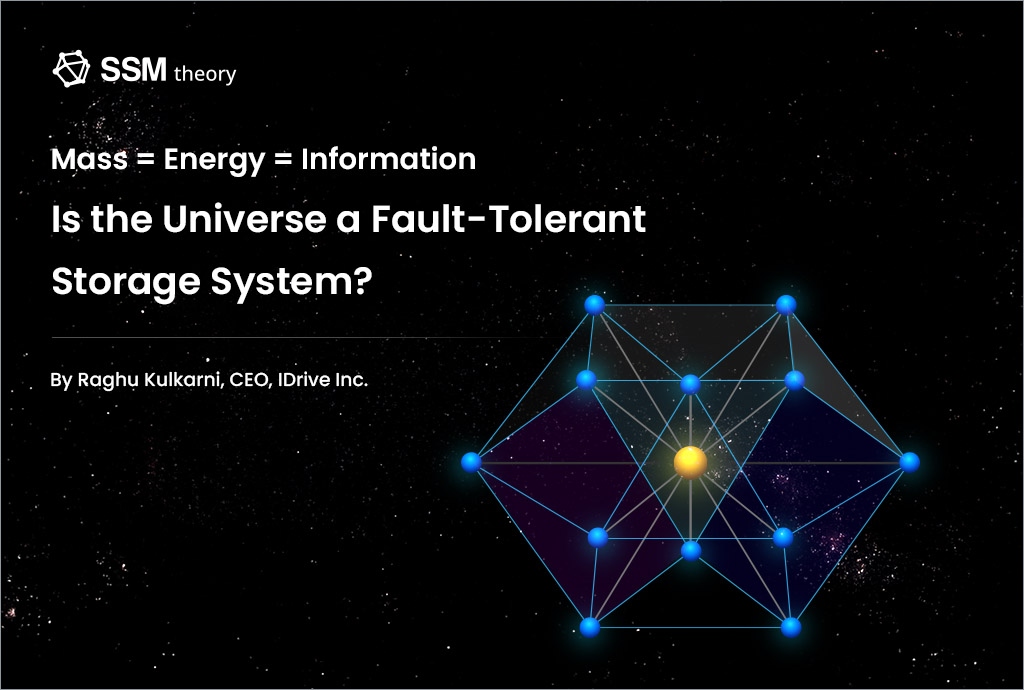
A new theoretical framework, the Mass-Energy-Information (M/E/I) Equivalence, proposes exactly that. Instead of treating particles as tiny physical spheres, the M/E/I framework treats the vacuum of space as a structured data grid (specifically, a Face-Centered Cubic or FCC lattice). In this model, particles are “topological defects” in the code, and mass is simply the computational overhead required to store and error-correct that information.
Over the past few months, the SSMTheory Group has published a four-part series of papers mathematically deriving the mysteries of the cosmos using pure data-storage principles. Here is how the universe manages its data:
1. Particles are Just Data (and Mass is the Storage Cost)
In cloud storage, when you save a file, the system has to allocate bits to store it and run background checks to make sure the file doesn’t corrupt.
In the M/E/I framework, the universe does the same thing. The vacuum runs a continuous quantum error- correcting code (specifically a [[192, 130, 3]] CSS code). When a particle like an electron or a proton exists, it acts as a “defect” in this perfect vacuum code. To keep that particle stable, the universe has to spend computational energy constantly verifying its boundaries.
We calculated this exact “verification cost” based on the geometry of the lattice, and the output perfectly matches the known masses of fundamental particles. An electron isn’t just a particle; it is a 1-bit topological defect.
Read the full proof: The Mass-Energy-Information Equivalence: A Bottom-Up Identification of the Particle Spectrum via FCC Lattice Error Correction
2. Nuclear Fusion is Cosmic Data Deduplication
If you have two identical files, good storage software will use “deduplication” to store only one copy and point the second file to the first, saving space.
When protons and neutrons bind together to form an atomic nucleus, the total mass of the nucleus is slightly less than the sum of its parts. Physicists call this the “mass defect.” In the M/E/I framework, this is literally data deduplication.
When particles merge on the FCC lattice, their shared data boundaries overlap. The universe’s error-correction code recognizes this redundancy and deduplicates the shared information through a process known in graph theory as a “Max-Cut.” The “missing” mass from nuclear fusion is just the storage space saved by deduplicating the redundant data.
Read the full proof: Mass-Energy-Information Equivalence II: Nuclear Binding as Max-Cut Deduplication on the FCC Lattice Code
3. Dark Matter is the Code’s Parity Overhead
To make data fault-tolerant, storage systems use “parity bits”—hidden, underlying data that isn’t the file itself, but is used to rebuild the file if a drive fails.
Astronomers know that 85% of the mass in the universe is “Dark Matter.” We can’t see it, but its gravity holds galaxies together. In our framework, Dark Matter is the universe’s parity data.
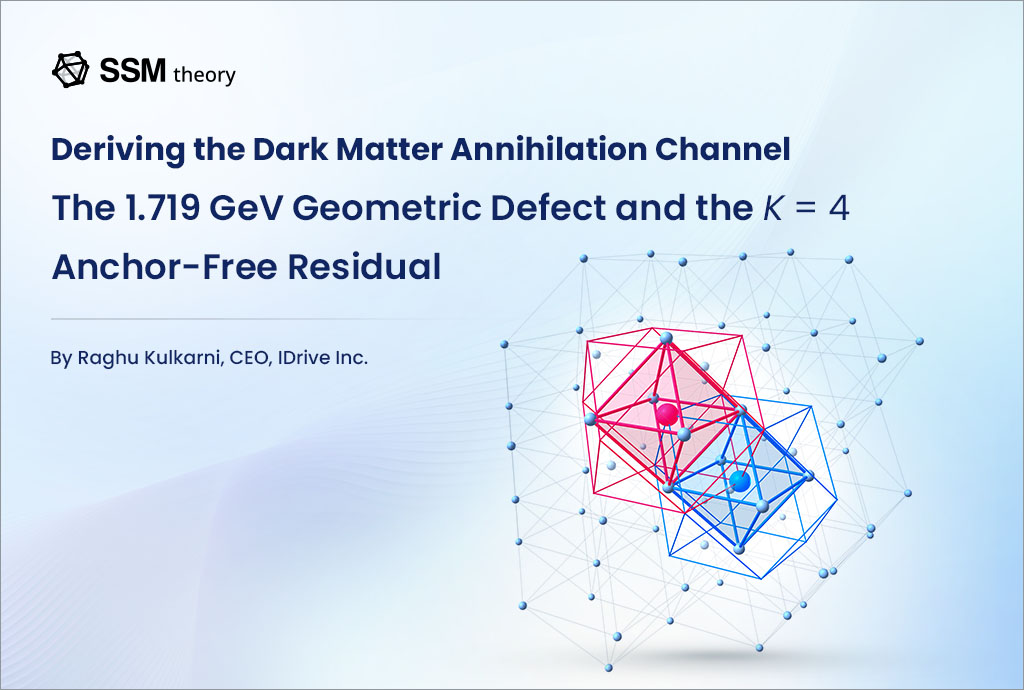
The 13-node geometry of the vacuum code naturally partitions into two sectors: a “visible” sector where our normal data (matter) lives, and a larger “hidden” sector required to maintain the stability of the lattice. When you calculate the exact ratio of the hidden storage sector to the visible data sector, it comes out to exactly 32 / 6—perfectly matching the observed ratio of Dark Matter to visible matter in the cosmos.
Read the full proof: Mass-Energy-Information Equivalence III: The Dark-to-Baryonic Ratio from Sector Partition of the FCC Lattice Code
4. Cosmic Expansion is the Limit of the Error Threshold
Every error-correcting code has a breaking point. If too many drives fail at once, data is permanently lost.
At the macroscopic scale, the universe is expanding, creating massive, empty “cosmic voids” between galaxies. Standard physics struggles to explain the exact density of these voids or the tension in the universe’s expansion rate.
But if the universe is an error-correcting lattice, a void is simply a region where the physical network has reached its maximum fault-tolerant threshold. By calculating the exact point where the [[192, 130, 3]] code breaks down (bond erasure), we derived the precise density of cosmic voids (1/3) and mathematically solved the Hubble Tension (the discrepancy in how fast the universe is expanding) without a single fitted parameter.
Read the full proof: Mass-Energy-Information Equivalence IV: Cosmic Void Density from the Error-Correction Threshold of the FCC Lattice Code
The Future of the Code
Viewing the universe through the lens of data storage isn’t just a fun metaphor—it is producing hard, verifiable mathematical predictions that solve some of the deepest problems in modern physics.
As we continue to push the boundaries of classical cloud storage and look toward the horizon of quantum computing, it turns out the ultimate blueprint for a perfectly decentralized, faulttolerant system has been hiding in the vacuum of space all along.
Explore the complete four-part M/E/I Equivalence series and dive deeper into the mathematics of the universe’s source code at the official SSMTheory hub:
https://idrive.com/ssmtheory