
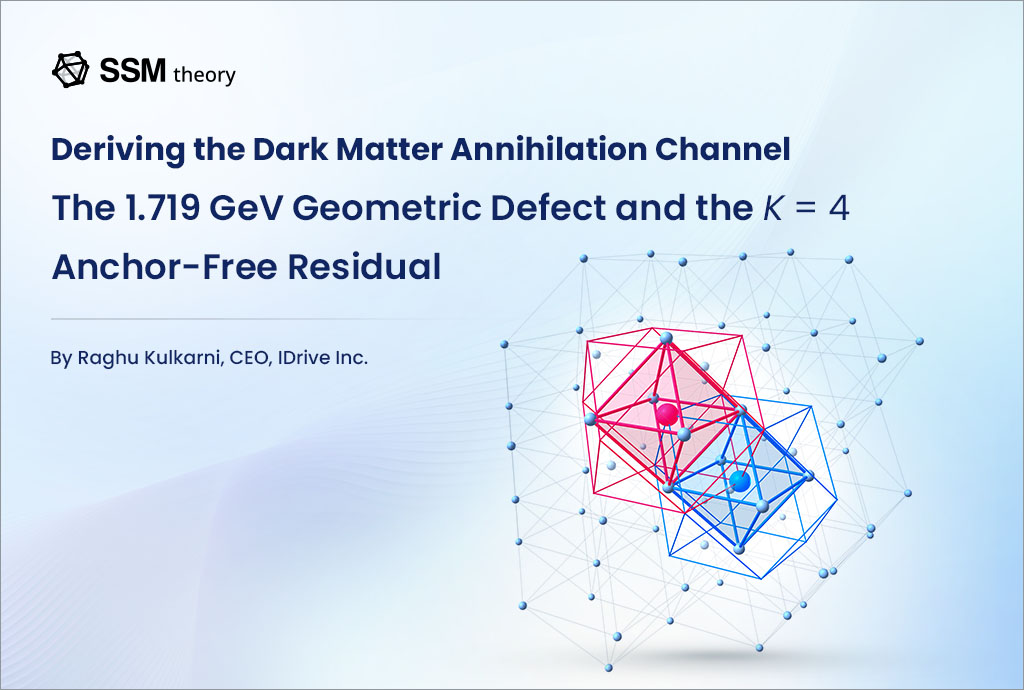
By Raghu Kulkarni | SSMTheory Group, IDrive Inc.
In the search for dark matter, the focus of the experimental physics community has shifted
toward the “Light Dark Matter” (LDM) regime (1 MeV – 5 GeV). Recently, astrophysics
has given us a fascinating clue: the Kang et al. (2026) observation of a distinct 1.5–1.6
GeV gamma-ray line in active galactic nuclei.
In the Selection-Stitch Model (SSM), this observation is not an anomaly. It is the
geometric signature of the vacuum lattice itself.
In our framework, physical space is fundamentally a face-centered cubic (FCC) lattice.
Dark matter is not an exotic new fundamental particle with arbitrary parameters; it is a
macroscopic structural anomaly. Specifically, the primary dark matter candidate (χ) is
a K = 6 octahedral defect—a node trapped symmetrically in an octahedral void of the
vacuum crystal.
By counting the number of displaced lattice bonds required to form this geometric
defect, SSM predicts the mass of this dark matter candidate to be exactly 1.719 GeV.
However, if two 1.719 GeV particles annihilate completely into two photons (χχ →
γγ), we would expect to see a gamma-ray line at 1.719 GeV. The observed astrophysical
line is around 1.58 GeV—nearly 9% lower. Why?
The Annihilation Channel and the 3D Collision Geometry
When two primary dark matter defects collide, they don’t just vanish into pure light. In
a crystalline vacuum, structural defects merge along specific geometric pathways.
Our latest paper formally derives this collision channel. If you look at two nearest-neighbor octahedral voids in the FCC lattice, you will find they share exactly one causal
interface: a single shared edge.
When two 1.719 GeV defects merge across this shared edge, the geometry dictates
that they undergo a semi-annihilation:
χ + χ → γ + χ
But what is χ′? It is a massive dark residual. Under the stability rules of the lattice,
the only stable, closed cages available to trap a node are the octahedron and the regular
tetrahedron. During the merger, the collision collapses into a single K = 4 tetrahedral
defect hinged exactly on that shared edge.
Explore the Geometry: You can view and manipulate an interactive 3D visual of
this exact topological merger (showing the two K = 6 voids sharing the green edge and
collapsing into the K = 4 residual) right here:
→ Interactive 3D Dark Matter Annihilation Visual
The Symmetric K = 4 “Dark Proton”
In the visible sector, a K = 4 tetrahedral defect forms a standard proton. To do this, the
trapped node must “select an anchor”—singling out one of its four bounding vertices as a
bulk-coupling channel. This anchor selection breaks the spatial symmetry (S4 → S3) and
generates the fractional charges and color that we observe in normal interacting matter.
However, the residual defect (χ′) left over from the dark matter collision does not
select an anchor. It occupies the tetrahedral void with full, unbroken S4 site symmetry.
Because it retains this complete symmetry, all four bond vectors sum to zero. The defect is perfectly neutral, colorless, and baryon-number-free by pure geometric symmetry. It is mathematically a stable local minimum of the bond-strain energy. This is essentially a “dark proton”—a structurally identical tetrahedral cage, but without the broken symmetry that makes normal matter interact with light.
Because it shares the exact same underlying topological cage disruption as the visible
proton, its mass is identical: 0.938 GeV.
A Parameter-Free Prediction
With the geometry fully defined, the kinematics are completely locked in. We have two
1.719 GeV dark matter defects colliding, emitting a photon, and leaving behind a stable
0.938 GeV anchor-free residual.
Using standard two-body kinematics, the energy of the emitted photon is calculated
to be exactly 1.591 GeV.
This value lands squarely within the observed Kang et al. centroid of 1.578 ± 0.048 GeV. There are no “hidden sector” forces to tune, no arbitrary mass parameters to fit, and no Supersymmetry to invoke. The 1.719 GeV primary mass, the K = 4 symmetric residual, and the resulting 1.591 GeV gamma-ray line are all direct, zero-parameter consequences of discrete lattice geometry.
Read the full mathematical derivation and the topological proof of the K = 4 anchor-free residual in the preprint here: