For decades, the foundation of modern cosmology has rested on a single, comforting assumption: the universe is perfectly isotropic. It looks exactly the same in every direction. Standard Big Bang cosmology backs this up by assuming that the universe inflated and “reheated” everywhere simultaneously.
But there is a glaring problem: the universe refuses to cooperate.
When the Planck satellite mapped the Cosmic Microwave Background (CMB)—the residual afterglow of the Big Bang—it confirmed a massive anomaly. One hemisphere of the sky is distinctly different from the other. Cosmologists call it the “Hemispherical Power Asymmetry.” Standard physics has no mechanism to explain this, dismissing it as an incredibly unlucky statistical fluke.
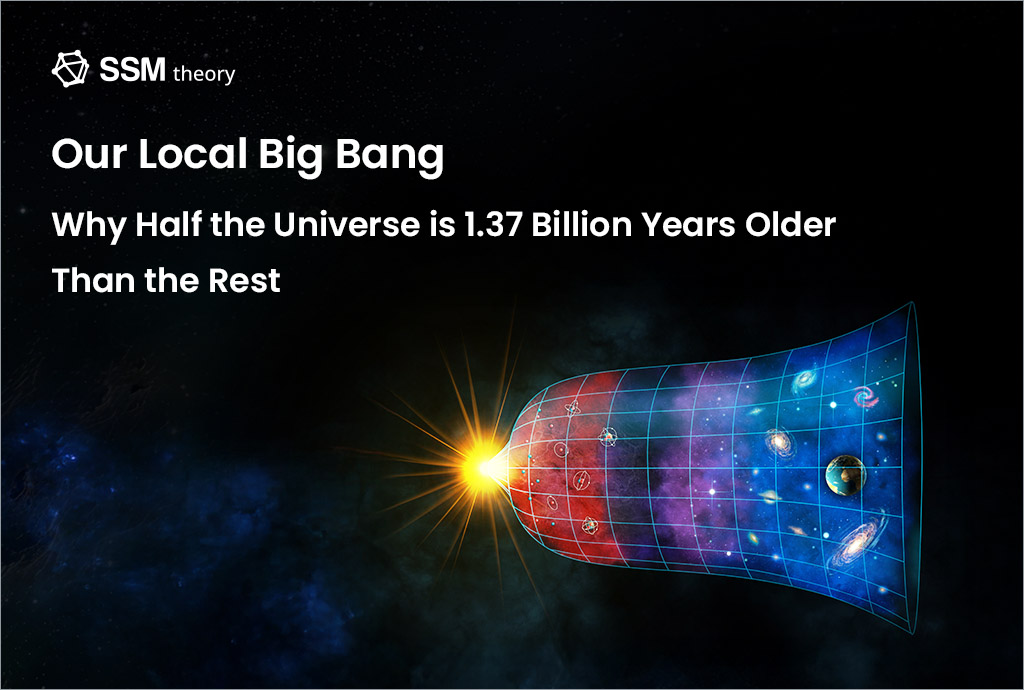
But what if it isn’t a fluke? What if the universe is lopsided because the Big Bang wasn’t a simultaneous explosion, but a physical wave that took 1.37 billion years to sweep across our sky?
The Wave of Creation
In the Selection-Stitch Model (SSM), the early universe undergoes a geometric phase transition. It shifts from a chaotic, hot state into a cold, highly ordered, rigid geometric lattice.
Think of it like water freezing into ice. A pond doesn’t freeze everywhere at the exact same millisecond. A crystallization front forms at a single nucleation point and spreads outward. In the SSM, the Big Bang is the latent heat released by this exact volumetric crystallization.
Because this wavefront propagates at a finite velocity, it took a specific amount of time to sweep across the volume of space that makes up our observable universe. The geometry is unambiguous: the hemisphere of the sky facing the origin of the wave crystallized first, and the antipodal hemisphere crystallized last.
The 1.37 Billion Year Gap
The SSM calculates the exact speed of this crystallization front based on quantum tunneling probabilities. The math reveals a permanent, scale-free age gradient across the diameter of our observable universe of approximately 10%.
When we evaluate this gradient against the currently accepted cosmic age midpoint (13.80 billion years), the results are staggering:
- The “Older” Hemisphere: ∼ 14.49 Billion Years Old
- The “Younger” Hemisphere: ∼ 13.11 Billion Years Old
The absolute chronological difference between the two poles of our universe is exactly 1.37 billion years. The CMB anomaly is not a fluke; it is the thermal shadow of a massive age gradient.
A Local Event in a Cosmic Ocean
This model forces us to completely re-evaluate reality. In the standard model, the Big Bang is everything, everywhere, all at once. But in the SSM, the crystallization wavefront extends vastly beyond the borders of our observable universe.
Imagine a single boat sitting in the middle of a dark, calm ocean. Suddenly, a massive, glowing swell rolls underneath it. To the sailors, that wave feels like the beginning of everything—it violently shakes their world and defines their entire reality. But the wave didn’t start at the boat, and it doesn’t end there. The boat is just experiencing a local, passing event.
We are the boat.
The Big Bang was not a global explosion; it was simply the moment this thermodynamic wave passed through our local coordinates. We happen to live in a patch of space that the front swept through roughly 13.8 billion years ago. Somewhere out there, far beyond our cosmic horizon, the Big Bang is still happening.
The Ultimate Test
If one half of the sky is literally 1.37 billion years older than the other, we should see an observable “maturity gradient” across the sky. Galaxies and supermassive black holes in the older hemisphere had over a billion extra years to evolve.
Incredibly, this is already showing up in the data. A recent analysis of the CatWISE quasar catalog revealed a distinct structural dipole in the evolutionary states of supermassive black holes—and it perfectly co-aligns with the CMB asymmetry axis.
Furthermore, a 5% age difference at the time the CMB was emitted would subtly alter the physical sound horizon. The DESI collaboration currently holds the exact Baryon Acoustic Oscillation (BAO) datasets needed to definitively confirm or falsify this geometric axis as a massive ∼ 7σ detection. The proof is already sitting on their hard drives.
The Big Bang wasn’t a singular “pop.” It was a wave of creation. And we are just now learning how to read the ripples.
Dive Deeper into the Theory:
- Read the full open-access paper on the 1.37 Billion Year Big Bang derivation:
https://doi.org/10.5281/zenodo.18843626 - Explore the foundational papers, source code, and mathematics behind the Selection Stitch Model at the official theory hub: https://idrive.com/ssmtheory