
By Raghu Kulkarni, CEO, IDrive Inc.
A few days ago, I shared a post here on the blog about a 300-line Python script I wrote. It was a discrete simulation designed to computationally generate the 3D vacuum of our universe from scratch, treating space as a literal tensor network rather than an empty void.
The simulation successfully built the exact 3D Face-Centered Cubic (K = 12) lattice required by my theoretical physics framework, the Selection-Stitch Model (SSM). But, as with any early-stage physics model or software build, it had a lingering vulnerability: I had to input a 5% probability variable to make it work.
In computer science, we call these “magic numbers.” In physics, they are called “free parameters”—arbitrary values typed in by the programmer to coax the math into giving the right answer.
I couldn’t leave it like that. So, I went back into the codebase and ruthlessly stripped out every single hardcoded assumption. I replaced them with strict, immutable mathematical laws. The result is a fully updated simulation with exactly zero free parameters. We are no longer giving the universe instructions; we are simply turning on the thermodynamic engine and watching nature compile itself.
Because the code now boots up the scaffolding of the universe using absolutely no humantuned inputs, I am officially calling this updated version “The God Simulation.”
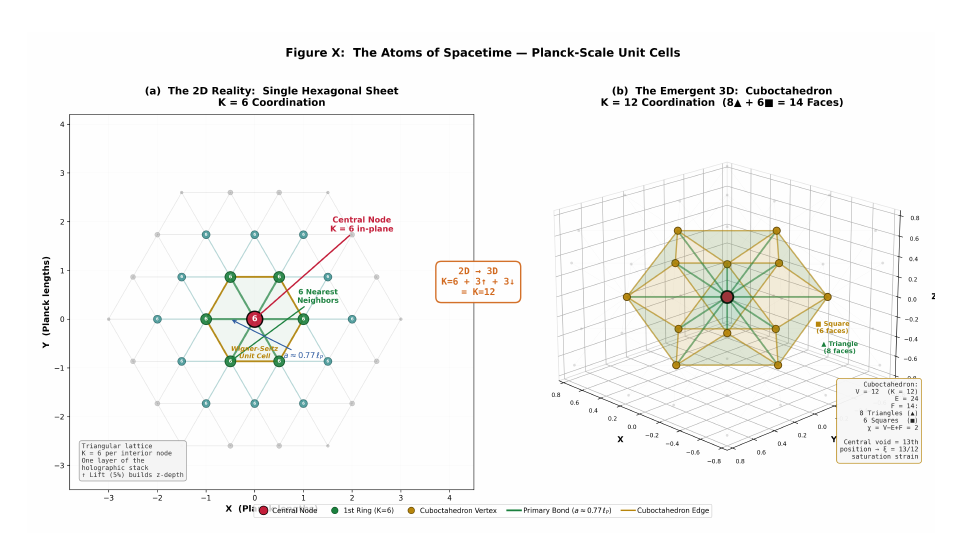
Here is exactly how the universe builds itself, mapping the strict technical physics directly to what it means in plain English:
1. The Base Layer: Gauge-Invariant Triangles
The Technical Language: The foundational generative operator is a 2D lateral Stitch, grounded in the lattice gauge theory requirement (Wilson, 1974) that the minimal physical, gauge-invariant unit of entanglement is a closed triangular loop.
The Narrative: The continuous mining act of nature. Just as a blockchain continuously mines and verifies new blocks to extend a trusted ledger, the universe continuously “stitches” elementary triangles together via quantum entanglement. Nature cannot build 1D lines; it must build closed, mathematically stable loops of information, resulting in flat, 2D hexagonal sheets. It is building the flat motherboard of reality. Sometimes it may have some variances, but over an extended length, it is mostly flat.
2. The 3D Leap: The e−3 Topological Barrier
The Technical Language: The 3D “Lift” operator requires transitioning from a 1D solution manifold (a continuous circle of probability) to a strict 0D solution manifold (exact intersecting points). The quantum tunneling amplitude for overcoming this 3-node topological barrier is exactly e−3 (roughly 4.98%).
The Narrative: The cosmic leap of faith. In my first simulation, I guessed that the universe built 3D space about 5% of the time. Now, we have the exact geometric proof. Popping out of “flatland” into a third dimension is thermodynamically incredibly difficult—it requires perfectly synchronizing 3 separate nodes at once. The strict statistical cost of that synchronization is e−3. It isn’t a dialed parameter; it is the fundamental tax nature pays to build depth.
3. The Saturated Vacuum: K = 12 Kepler Packing
The Technical Language: Driven by holographic stacking at the e−3 tunneling limit, the 2D sheets organically bond to neighbors above and below (6 + 3 + 3 = 12), perfectly satisfying the 3D Kepler kissing number theorem for maximum density.
The Narrative: The ultimate data compression limit. Once the 2D sheets stack and connect, every node locks into exactly 12 connections. Mathematically, 12 is the maximum number of equal-sized spheres that can touch a central sphere. The vacuum of space isn’t empty; it is a perfectly saturated hard drive. It has reached absolute maximum data density, meaning the “empty” space between galaxies is actually geometrically full.
4. The Origin of Matter: Polycrystalline Grain Boundaries
The Technical Language: Because of the strict 7.36◦ Regge deficit angle inherent to tetrahedral tiling, the K = 12 continuous lattice cannot tile infinitely. The geometric strain forces the formation of a polycrystalline structure, yielding 1D and 2D topological grain boundaries containing frozen K < 12 defects.
The Narrative: The “bad sectors” and physical scars of the universe. You cannot tile 3D space perfectly forever without the math eventually straining and snapping. As the universe expands, the network fractures into different perfectly packed domains. Where these domains clash, the network gets tangled. Nodes get trapped with fewer than 12 connections and become permanently frozen. To us, looking out into the cosmos, those frozen network scars are what we call matter, mass, and stars. We are literally made of the vacuum’s bad sectors.
5. Demystifying Dark Energy: The Cost of Expansion
The Technical Language: Dark energy is not an intrinsic fluid, but the macroscopic geometric bending stress of the expanding holographic sheets. By renormalizing the bare 2Dboundary tension by the natural 13/12 bulk volumetric ratio (the 13-node fundamental cluster vs. its 12-node boundary), the model geometrically predicts a dark energy density fraction of 67.5%.
The Narrative: The cost of running the server. Dark energy is the biggest unsolved mystery in physics, appearing 10120 times weaker than standard quantum theory predicts. But in a network universe, dark energy isn’t a magical, invisible fluid. It is simply the mechanical, thermodynamic cost of “stitching” new space. As the universe expands, the 2D sheets are forced to stretch and bend. When we calculate the pure elastic tension of this bending and apply the basic 13/12 geometry of a 3D volume, the math spits out a dark energy fraction of exactly 67.5%. This flawlessly matches the best telescope observations of our universe, without a single tuned parameter.
No Cheat Codes
When you run the updated code, the computer applies these strict, parameter-free laws. It doesn’t know what a 3D universe is. But as the script runs, the flat sheets automatically buckle, tunnel through the mathematical barrier, and zip themselves together into a massive, polycrystalline 3D universe filled with stable vacuum, frozen matter, and dark energy.
There are no cheat codes. There are no fudge factors. It is just raw geometry and entropy acting as the ultimate architects of space and time.
You can explore the full SSM framework at https://www.idrive.com/ssmtheory-quantum/ | https://www.idrive.com/ssmtheory-physics/.
To read the full mathematical proofs and access the zero-parameter open-source Python code, you can view my theoretical preprints here:
- Constructive Verification of K=12 Lattice Saturation (Zenodo: 10.5281/zenodo.18294925) (Under Peer Review)
- Dark Energy as Geometric Bending Stress of Holographic Vacuum Sheets (Zenodo: 10.5281/zenodo.18753874) (Preprint)
We spend a massive amount of time optimizing networks at IDrive. It turns out, nature has been running the ultimate, zero-parameter network optimization algorithm since the dawn of time.